
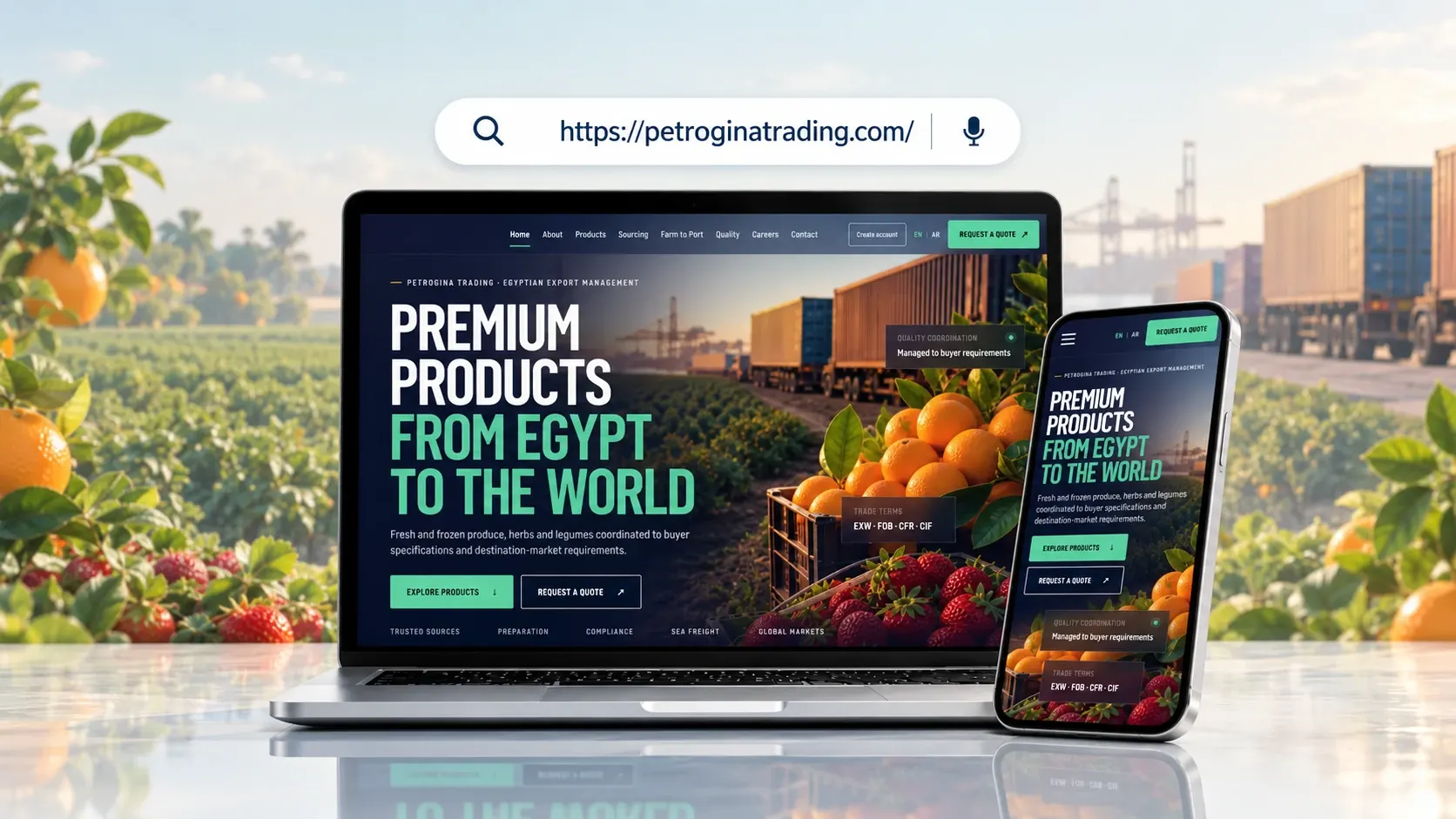
B2B platform
E-commerce
2026
Petrogina Trading — agricultural export management platform
Laravel · Filament · Livewire · Tailwind CSS
E-commerce development
Omar Khaled builds custom e-commerce and B2B ordering platforms on Laravel: product catalogues, carts and checkout, local and international payment gateways, shipping and order tracking — plus a Filament back-office for daily operations.
01 — The problem
Template stores work until your business model doesn’t fit them: custom products, quotes instead of fixed prices, regional payment providers, or workflows like made-to-order design.
A custom build lets the store follow the business instead of the other way round.
02 — What you get
Variants, specifications, bilingual content and SEO-ready product URLs.
Cart, checkout and payment gateway integration with verified webhooks and stock reservation.
Order workflow with status history, shipping zones and customer-facing tracking.
Filament dashboard for orders, products, customers, payouts and analytics.
03 — How we’ll work
We map goals, users, constraints and what “done” means. You get a written scope with priorities and a fixed or capped estimate.
Data model, key screens and integrations are agreed before code, so surprises surface early and cheaply.
Working software on a staging server every week, covered by automated tests, with a short written update.
Production deployment, monitoring, documentation and a walkthrough of the admin panel — then optional ongoing support.
04 — Related work
Laravel · Filament · Livewire · Tailwind CSS

Laravel · Filament · PHP 8 · JavaScript
05 — FAQ
Yes. Payment integrations are built with server-side webhook signature verification (for Paymob, HMAC-SHA512) and stock that is reserved during checkout and released if payment never completes.
Yes — bilingual catalogues with right-to-left Arabic layouts are a standard part of the build, including localized URLs and SEO metadata.
If your products and checkout fit Shopify, use Shopify. A custom Laravel store makes sense for custom products, B2B quotes, unusual workflows or deep integration with your own systems.
Next step
Tell me about your project or your team in a few lines. You’ll get a reply within 24 hours with next steps — no sales script.